Protocol as Fuel
How one small nostr primitive — the scoped, revocable data grant — fueled a whole portfolio of applications, and what that says about building on protocols instead of platforms.

Most software portfolios grow sideways: a company ships a product, then ships a second product, and the two share a login page and a billing system and not much else. This is a story about a portfolio that grew upward — seven public repositories, each one standing on the same ~300-line protocol implementation, each one built because the layer below it hit a real wall.
The primitive
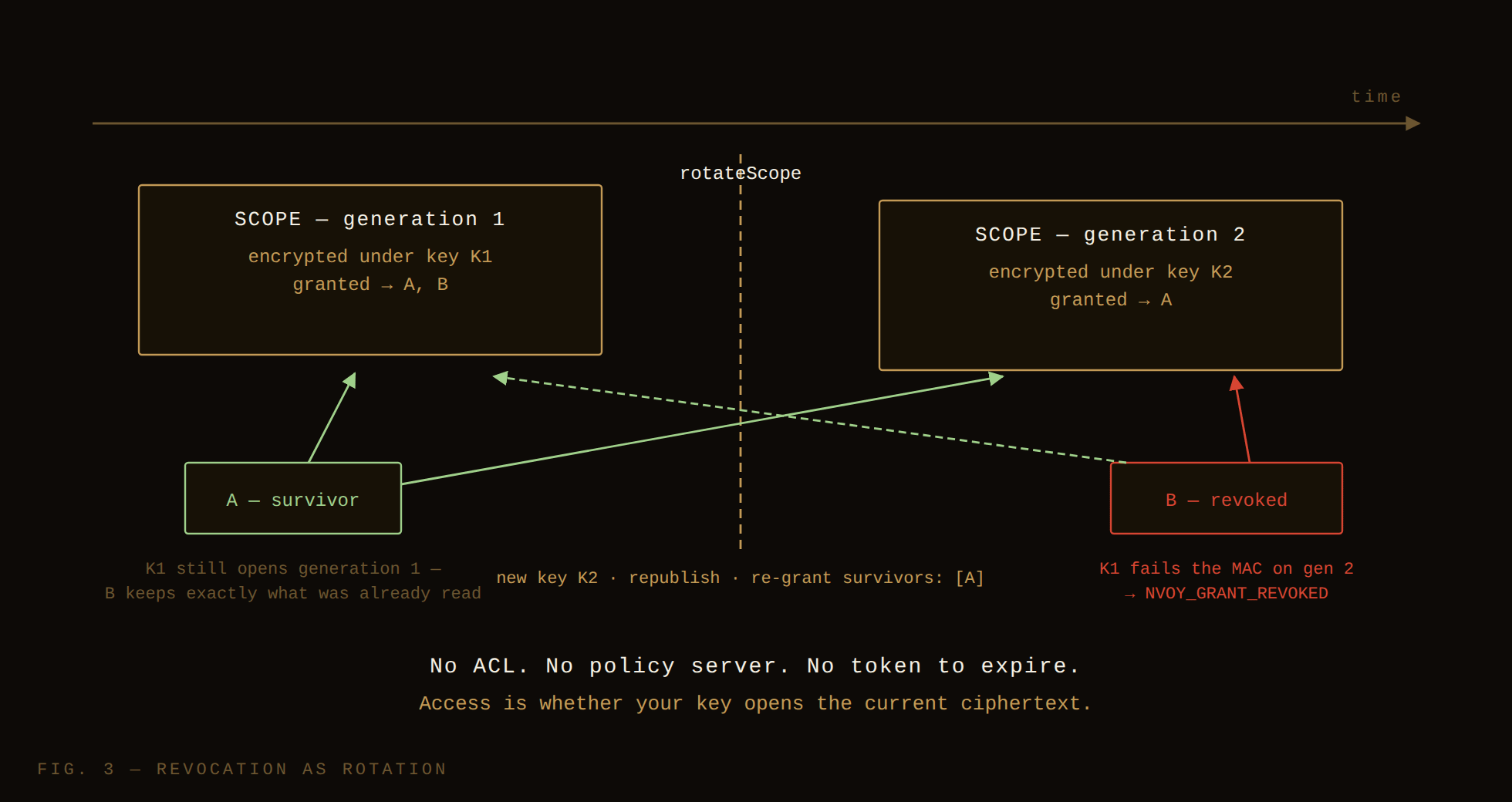
NIP-DA — Scoped Data Grants — adds one missing thing to nostr. Relays are excellent at broadcast and terrible at confidence: DMs are snapshots you can never update or retract, and anything more sophisticated usually reintroduces the server you were trying to escape. NIP-DA’s answer is a scope: a publisher-owned, encrypted, addressable data set (kind 30440) whose key travels to each reader as a gift-wrapped grant (kind 440 inside 1059). The publisher keeps authorship forever; readers dereference the current version; and revocation is not an ACL edit — it is a key rotation. Re-encrypt, re-grant the survivors, done. The revoked party’s key simply stops opening the current ciphertext.
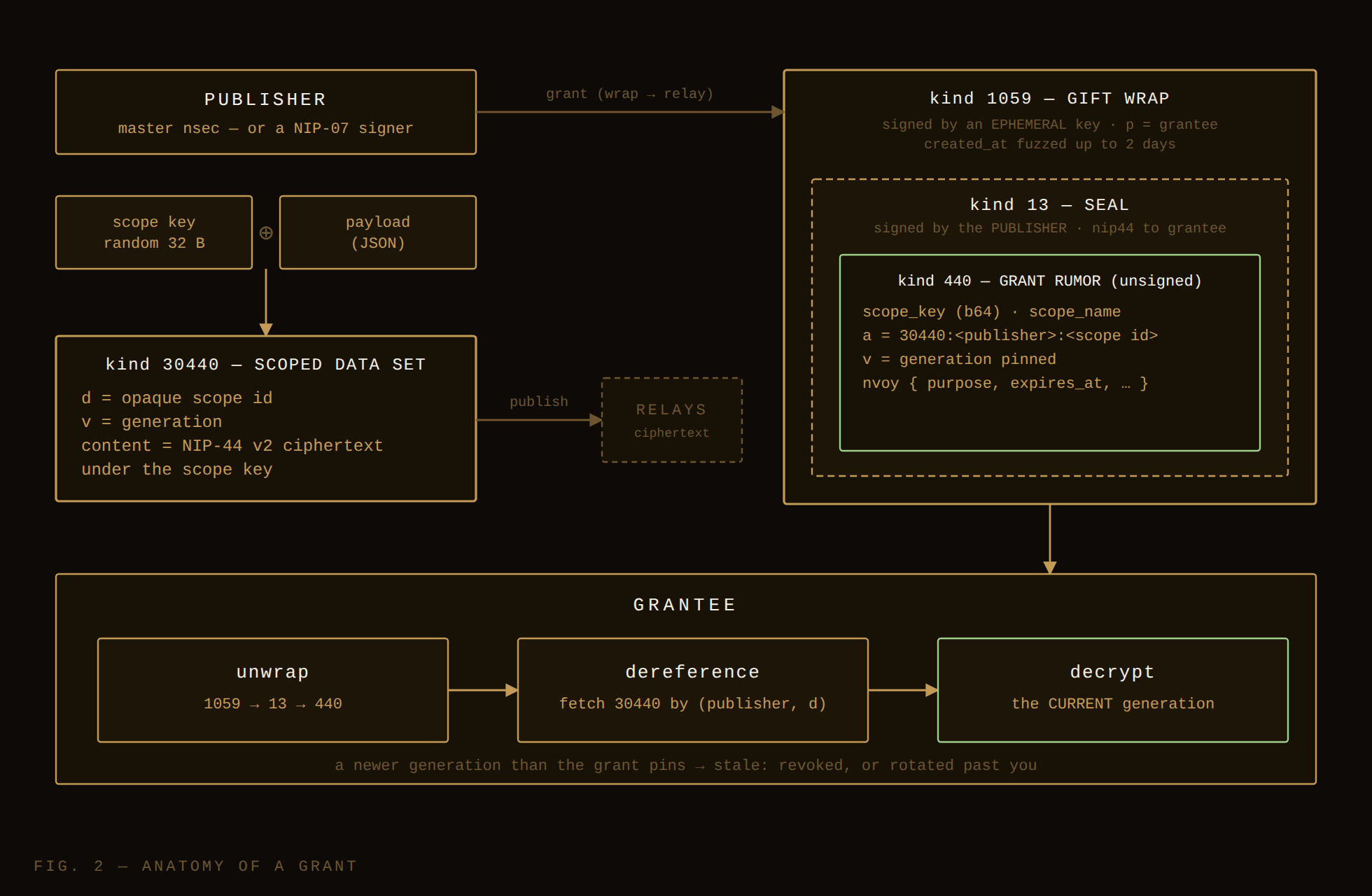
Two design choices made everything after possible:
Honesty. A revoked reader keeps whatever plaintext they already read, and the protocol says so out loud. No pretend un-sharing.
The signer interface. Every operation accepts either a raw key or a NIP-07-shaped signer object — so a web page can author scopes and issue grants under a user’s real identity without the secret key ever entering the page. This one abstraction was designed in before it was needed. It was needed.
The portfolio it fueled
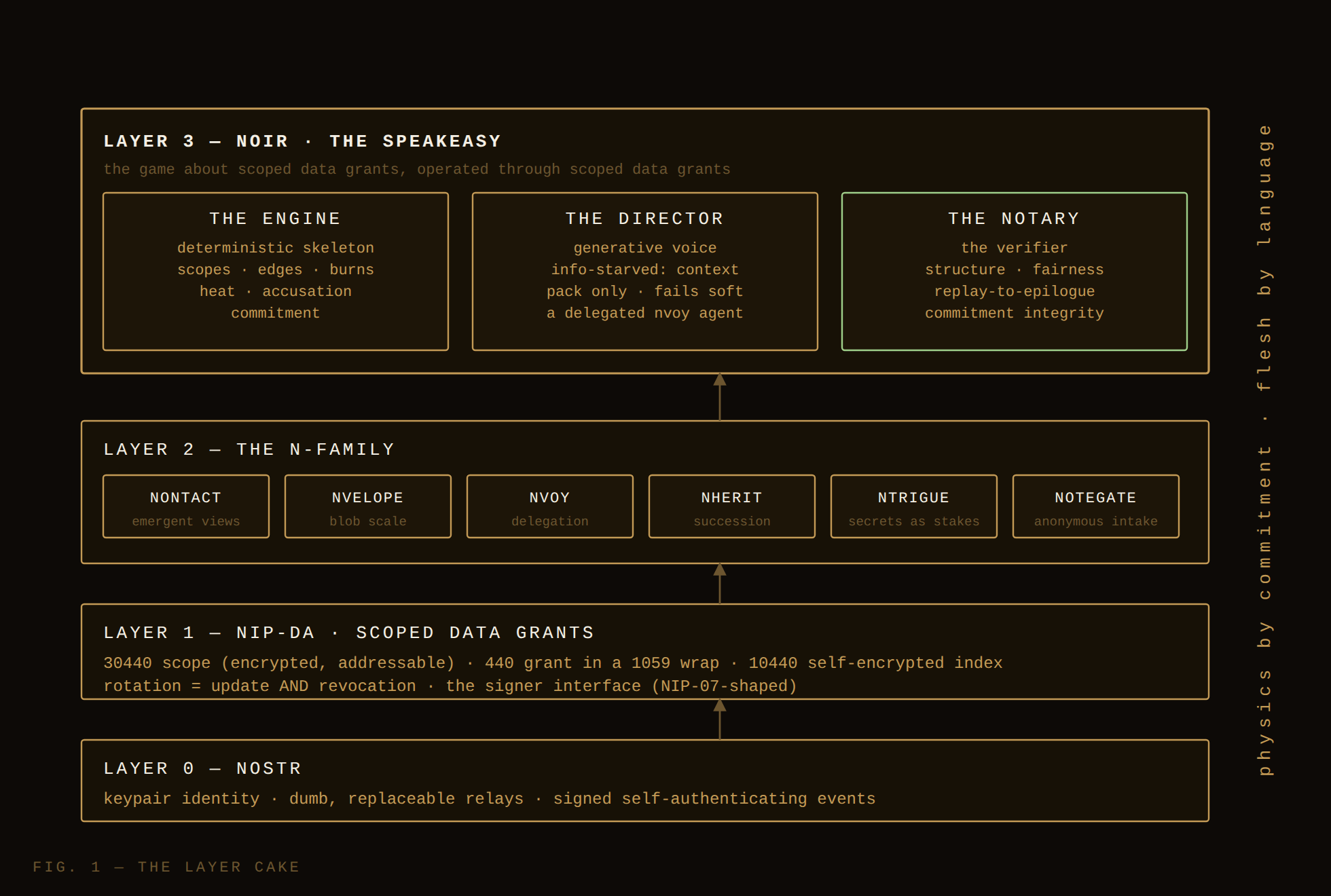
Nontact came first, alongside the protocol repo itself: a contact-card manager. Its insight is that an address book shouldn’t be an app’s database — it’s an emergent view, the sum of what people currently grant you. Update your card once; every holder dereferences the new truth. Move, change numbers, remarry — one edit, everyone current, and anyone you drop simply stops seeing updates.
Nvelope pushed on scale and lifecycle: live document sharing where a shared file is a scope, revocation replaces expiring links, and recovery needs only your key. Blobs too large for an event ride encrypted on Blossom with the key delivered by grant — same wire, bigger cargo.
Nvoy made the leap that changed the trajectory: the grantee became software. Delegating data to an AI agent is the moment access control stops being about politeness and starts being about survival — and the OAuth world has the wrong shape for it. A bearer token delegates access into a system that keeps the data; Nvoy delegates the data, end-to-end encrypted to the agent’s key, dereferenced live at run time, severable in one keystroke. Revocation surfaces to the agent as a clean NVOY_GRANT_REVOKED on its next read. Terms — purpose, expiry, no-persist — ride the grant and are enforced as compliance, not cryptography, disclosed honestly; the delegator’s real lever is always rotation. The agent side mounts as an MCP server, so any MCP-speaking framework consumes delegated data with zero nostr knowledge.
The family kept growing on the same fuel, each sibling pointing the primitive at a different hard problem. Nherit turned it toward time: a family break-glass legacy vault — one estate record in per-beneficiary scopes, heirs holding revocable grants, the whole thing reconstituting from a single key printed on paper. No company between you and your family. Ntrigue turned it toward adversaries: a phones-only party game of secrets, dilemmas, and blackmail, where every answer is an encrypted scope and pairwise prisoner’s-dilemma exchanges decide who sees what. Its design law — you can revoke a secret, but you can’t un-tell it — is the protocol’s honesty clause played for stakes. Notegate turned it toward the newsroom: serverless tip intake where a tip line is a keypair, sources are ephemeral keys with a 12-word phrase as their only way back, proof-of-work is the spam toll, and the grant index is the case docket.
Noir (play it) then asked the unreasonable question: can the primitive carry everything? A whole game — content, permissions, identity, agent management, feedback, even payment pointers — with no other trust system in the building? It can. Documents are scopes; discovery is a grant; betrayal is a rotation; the AI game master is an Nvoy agent whose entire authority is a revocable grant from its human master; playtest feedback travels back as scopes signed by the master’s own key; and the newest step delivers entire worlds — a steampunk era as pure data — over the same wire, gated by a mechanical fairness prover before any of it may be played.
The pattern worth stealing
Nothing in this stack was speculative infrastructure. Each layer was pulled into existence by the layer above it hitting a wall. Contacts needed liveness; documents needed scale; agents needed severability; the game needed tables; tables needed delegation; generated worlds needed a notary. When a protocol is small enough to vendor as one file and honest enough to state its own limits, applications compose on it the way the applications’ features usually compose inside a single product — except here, the portfolio’s products interoperate with no adapters at all. Nvoy’s console manages Noir’s game master without one line of Noir-specific code, because “an agent holding a revocable grant” is the same object in both worlds.
That’s what protocol-as-fuel means. Not a platform with an SDK and a partnerships team — a primitive with properties, and a family of applications that are each, in the end, the same three lines:
receive the grants addressed to me
keep the newest per scope
dereference and decrypt the current truth
Everything else is what you choose to encrypt.